What does an artist do after they’ve achieved a major milestone? For Rhonda Holy Bear, you admire the view for a moment, and then get back to work.
A year ago, Holy Bear (Cheyenne River Sioux) won the prestigious Best in Show award at the 2021 Santa Fe Indian Market. The piece, a meticulously designed doll, was titled Lakota Honor – Suwakan Ayutan Win – Sees the Horses Woman. She describes her multimedia three-dimensional art works as “Plains traditional art figures.” Holy Bear says that even when she pulls the work out of the box today, she’s still breathtaking. The piece took her more than 10 years to complete for the competition last summer and even though the piece won the top award, it’s still not complete.
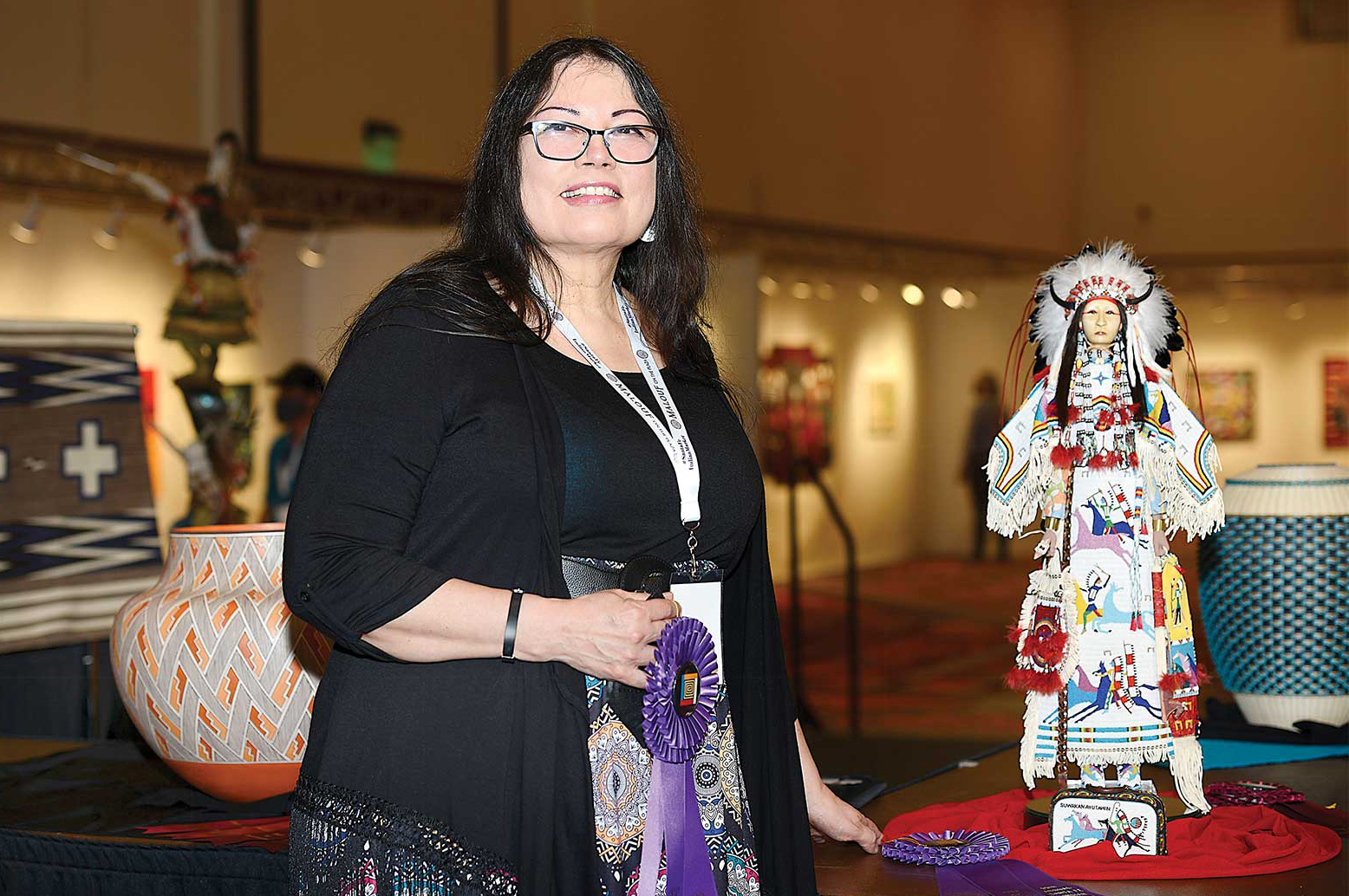 Rhonda Holy Bear with her Best of Show winner at the 2021 Santa Fe Indian Market. Photo by Daniel Nadelbach.
The artist models her pieces after the Great Plains tribes, and not just her own. She depicts imagery from neighboring tribes, viewing them all as a connected family—describing them as related through similar life ways, just as all the Plains People followed and hunted the buffalo.
For Lakota Honor, the theme is all about horses and horses running. She used her transitional art figure’s dresses to depict entire stories. “When we open up the dress on the side, there are three more layers, and they’re painted underneath. She’s wearing another layer called a war honor dress,” says Holy Bear. The form is all carved out of wood, and when opened the contours and shapes of the hand-carved body are visible. Her moccasins and leggings are beaded, including the soles. Adorning the figure are tiny antique Venetian and Czech micro seed beads which have not been made since prior to World War II—both world wars collapsed the entire bead industry.
Lakota Honor – Suwakan Ayutan Win – Sees the Horses Woman is a tribute to Holy Bear’s grandmother, Josephine Sees the Horses Woman, who was 4 years old at the Battle of Little Bighorn. “This particular piece honors Lakota men who lost their lives on the battlefield, and we had a family member die on the battle field,” she says. “My grandmother was picking turnips out in the field, and the men on horses were riding up. Her uncle picked her up, and carried her to the ravine for safety during the battle. If you lost a man on the battlefield, the woman would wear their regalia, his pipe, his pipe bag and any of his other things for special societies like the White Horse Society. This society hunted and fed the poor, and is symbolized by the penny bag on her belt. The society would take care of everyone. They would take their money and give pennies to those that needed to feed their families. Our society was known as the generous people.”
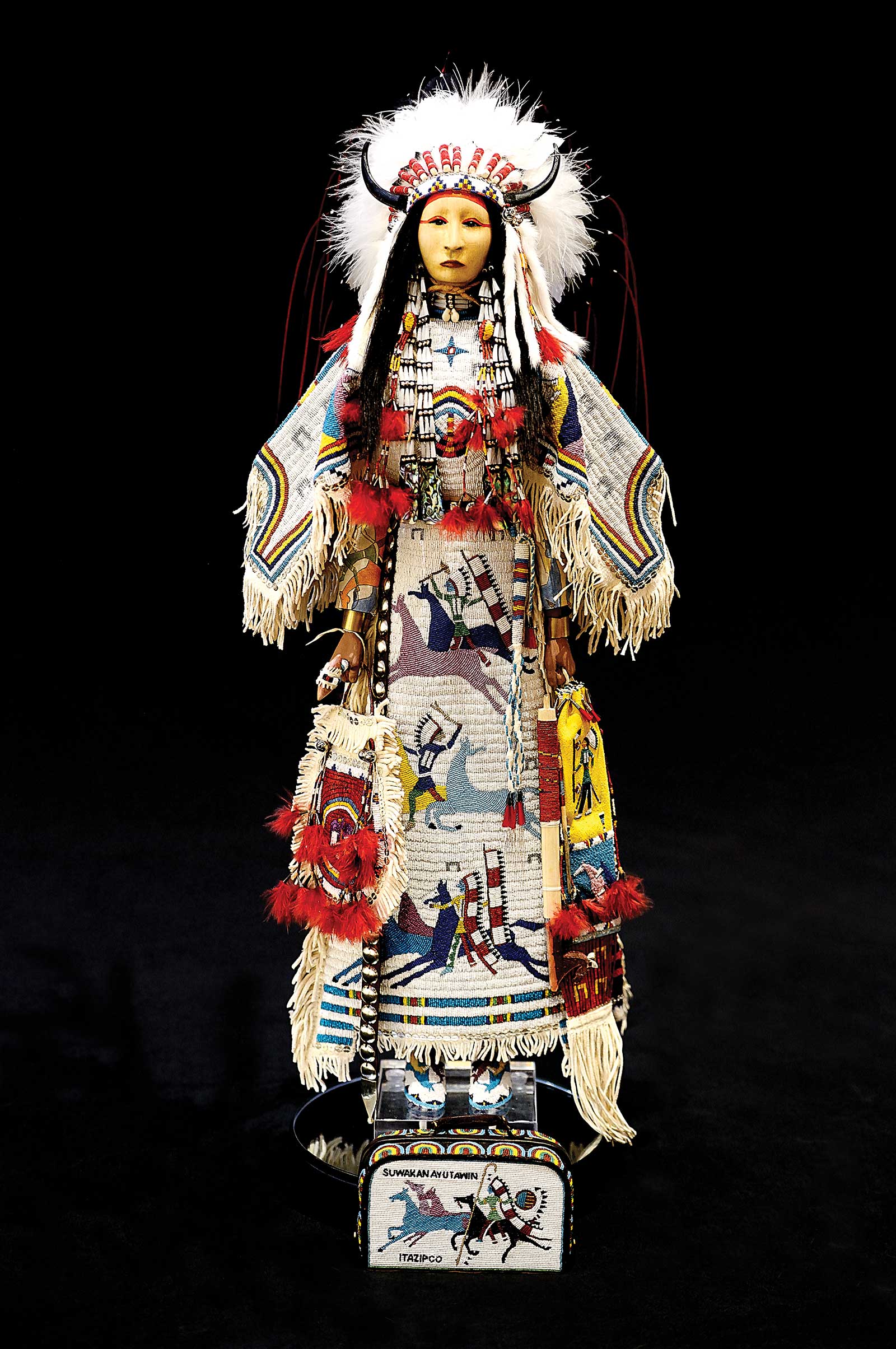 Lakota Honor – Suwakan Ayutan Win – Sees the Horses Woman, the Best of Show during the 2021 Santa Fe Indian Market. Photo by Daniel Nadelbach.
Holy Bear’s piece was intricately created with countless micro quills; all while creating the entire piece to scale. She used porcupine quill and genuine sinew, and brain tanned and naturally tanned her own deer hides. Her belt has very specific, symbolic detail. The figure has an awl case, a spoon, a strike-a-light case, an antler scraper, a real knife and sheath, and a war club to hold. She has a little quilled turtle that is sometimes worn on the neck, but Holy Bear placed it on the belt. The penny bag has sage and horse stealing medicine, and also holds real miniature Indian Head Penny coins that are 4mm in size. Her pipe bag is micro beaded with 24-O, the smallest in the world, with the pipe made of real pipestone with an ash stone mouthpiece, and is covered with quillwork wrapping. She even included quillwork on the pipe bag, featuring beadwork with tiny, hanging quills. Astonishingly, she even cut and hand rolled cones, but with tweezers. About 32 different skills and art techniques went into the piece, which also has a war bonnet that would have been from her relative that died on the battlefield. The war bonnet is hand painted with a little brow band and horns.
Holy Bear now takes to social media to share with collectors and other people wanting to learn. “I’m studying Lakota, but I’m not fluent. Anytime I give a video or live talk I always include some of my language,” says Holy Bear. “My grandparents were fluent speakers, but they stopped teaching Lakota to us as children, much like what has happened to many descendants of fluent speakers. I grew up in the 1960s, and when I was real small, my grandparents spoke it. When I moved away with my mom, it wasn’t spoken in our home.”
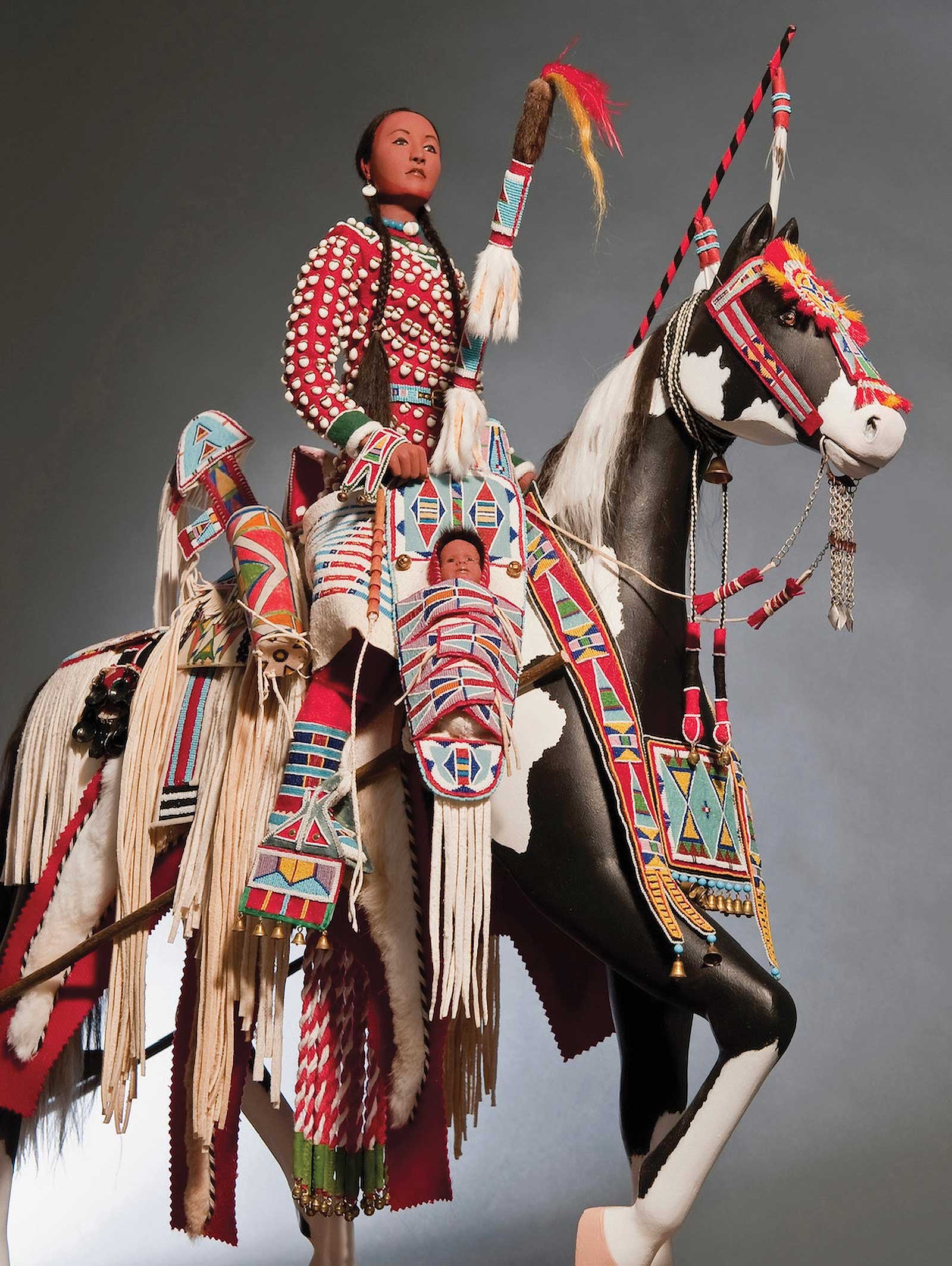 Maternal Journey (detail), 2010, wood, hide, cloth, paint, glass beads, hair, shell and metal. Image courtesy the artist.
In addition to Holy Bear using her art as a cultural learning tool, she also uses it to tell the story of her Lakota tribal language, like the application of the Paha Stich in her winning piece. Holy Bear explains: “We want to reclaim the name of the stitch in our language, and get rid of the derogatory term ‘lazy stitch.’ Our grandmothers called it a rolling-hill stitch. It wasn’t lazy at all and it alluded to the hills of the land around them. If we can change racist mascots, surely, we can change the name of a stitch. It’s important to use our Indigenous languages instead of conditioning us to change our language and words.” The other stitch she uses is the two-needle stitch—numpa thahinspa-cik’ala ksu’ in Lakota.
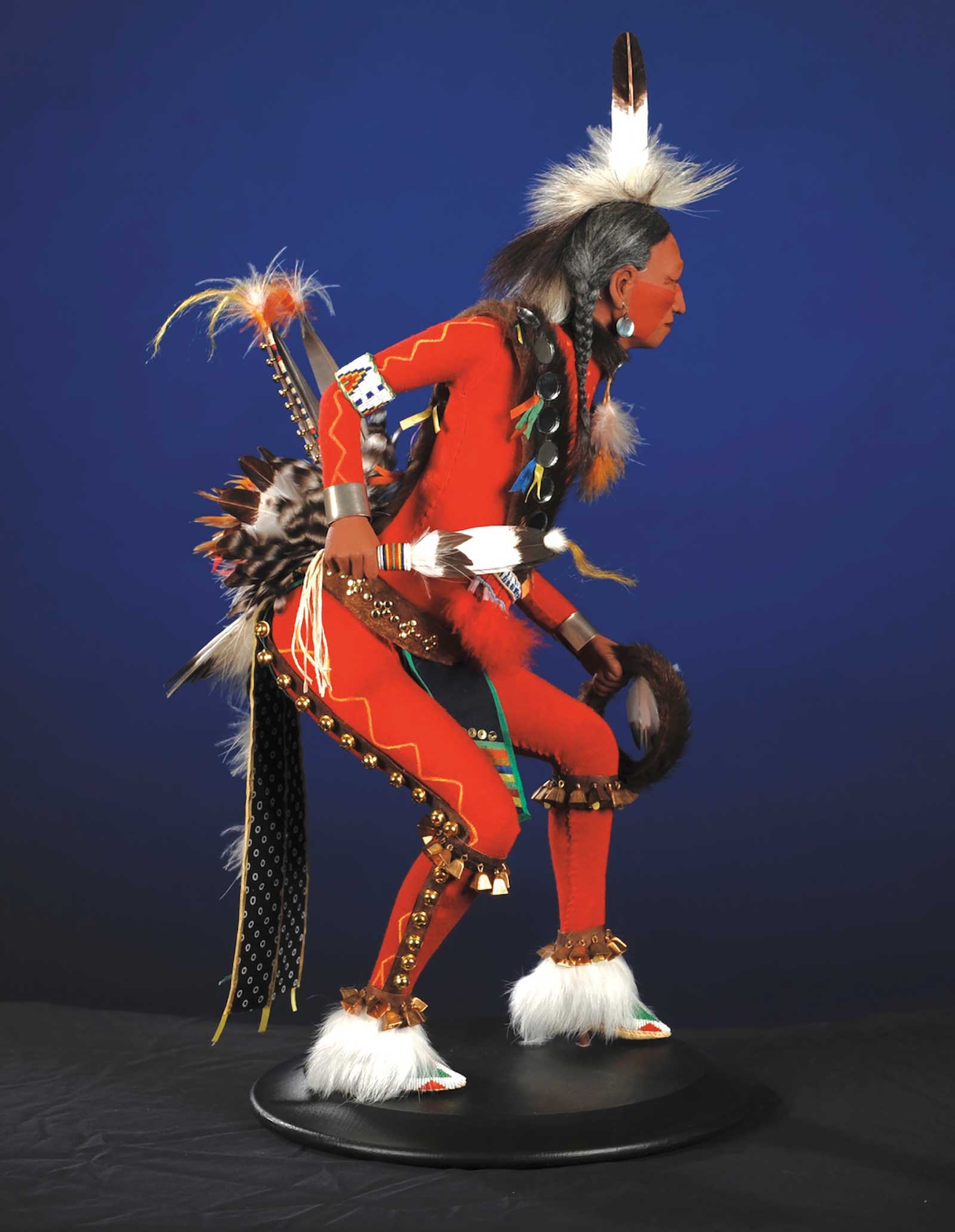 Lakota Grass Dancer, air-dry clay over wire, cotton, otter skin, mirror, silk ribbon, porcupine quills, shells, seed beads, metal, hide, brass and copper bells, hair and paint, with hand-painted craft feathers
When Holy Bear first went to Indian Market around 1980, she noticed there was a gap in the market and saw an opportunity. In 1985, SWAIA had a radio commercial for a fellowship that caught Holy Bear’s ear. She applied, won and received a booth space and $2,000. She filled her booth with small figures and horses, and to her surprise, she sold out in only 15 minutes. The next year saw the same results. Her career took off and she found herself with gallery representation in Santa Fe. During that time, she was busy filling galleries and wasn’t able to participate in markets, but she continued to travel to museums and archives across the country to learn. “I visited Chicago and studied at the Field Museum,” Holy Bear says. “I drew everything I could observe and visited their vaults. I read their books and scoured everything I could find in their photography departments.” After about 16 years, she returned to markets, but kept researching and learning. “I did a porcupine quill workshop for the National Museum of the American Indian to help their interns learn how to dye them, how to work with them and how to use them properly,” she recalls. “Quillwork is attuned to mean ‘to embroider’ or ‘to decorate’—Wo’skapie is the Lakota word for ornamental porcupine quillwork.”
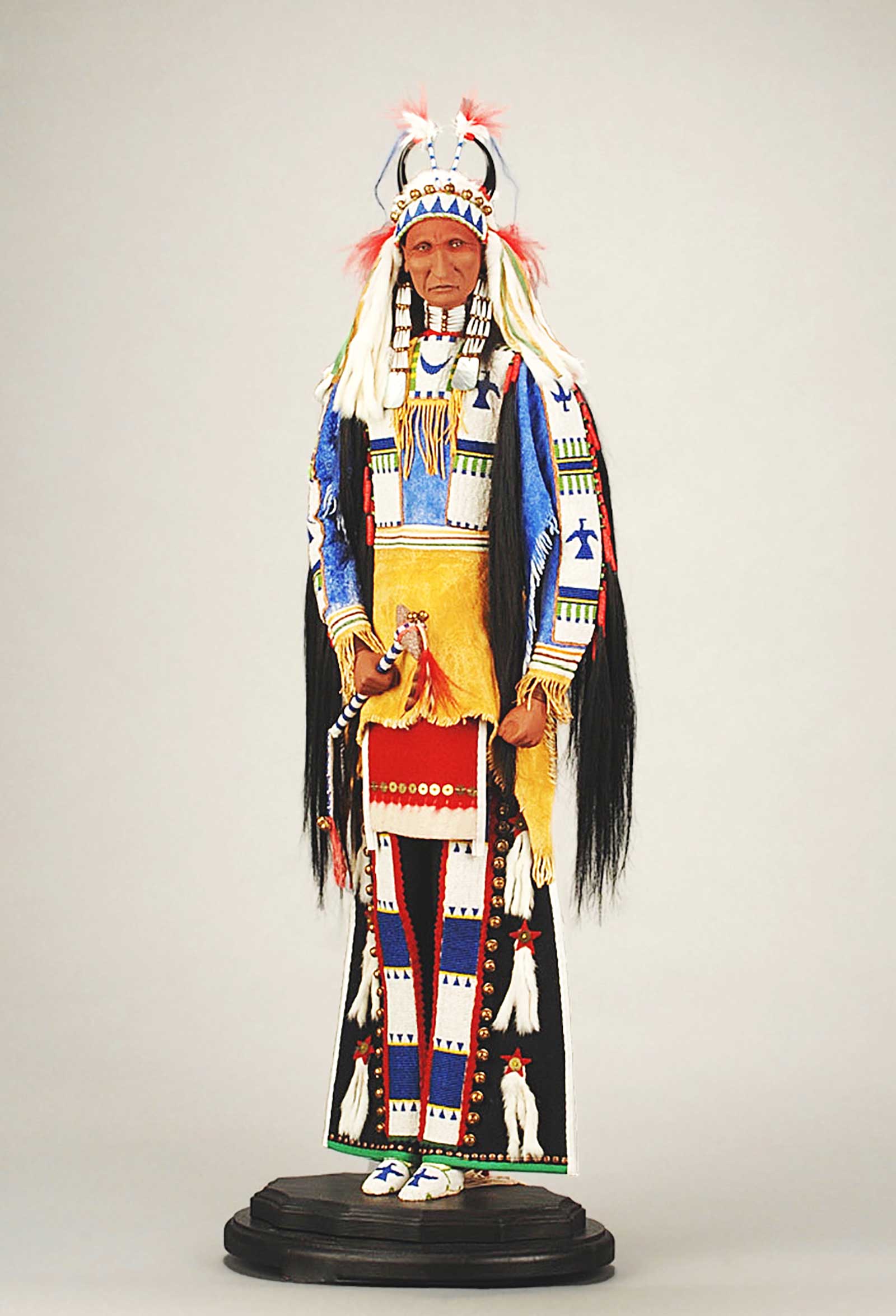 Thunderbird, basswood, paint over the wood, brain-tanned hide, wool, hair, ermine skins, horn, seed beads, shells, brass bells, craft feathers, stone and ribbon.
Her Best in Show piece, when completed, will be going to the Barry Art Museum in Northfolk, Virginia, in September 2022. Holy Bear will give a virtual lecture about the history of the trade beads, including beading techniques that her people developed. She has a solo exhibition that is currently open, and will run until 2023. She also has eight pieces at the Brinton Museum in Big Horn, Wyoming. For the 2022 Santa Fe Indian Market, Holy Bear excitedly says she’s bringing one “really nice piece, if she doesn’t sell before I get there! I’ll have another piece in a couple of years, a large one, too! I’m continually working on one as a tribute to my grandmother, as I create commissioned pieces.”
Holy Bear’s booth for the 2022 Santa Fe Indian Market resides across from La Fonda on the Plaza.
Powered by Froala Editor